Ghostly Viking Fingers
What sixty years of prevalence studies fail to tell us about Dupuytren's disease


In 1962, a surgeon in Manchester wanted to know how common Dupuytren’s disease is.
P. F. Early, M.B., F.R.C.S. Camb., who had previously been a surgical registrar at Mile End Hospital, London, asked himself what proportion of people have the disease, and whether the percentage was different from one country to the next. The medical literature offered no answer. In it, he found percentages that had been worked out from selected groups, from surgical wards, and care homes, from samples taken in various cities, and from homes for veteran soldiers. He found percentages that lumped everyone together, men and women, young and old. He found inconsistent definitions of what it meant to have Dupuytren’s disease. He found no answer to the question: how common is the disease?
He then surveyed industrial workers, and residents in a care home, and looked at numbers collected from a sample of people in a town called Leigh, not far from Manchester. He was able to show that prevalence rose steeply with age and was consistently higher in men than women, although the sex difference narrowed in old age. He found little evidence that manual work was a major determinant of disease occurrence and no convincing association with common rheumatic diseases. But he did find a strong association with epilepsy. People in an epileptic colony had Dupuytren’s disease far more often than expected from the age- and sex-specific rates in his comparison populations.
Having explained to his readers the limitations of the data available to him, and us, Early then did something strange.
He mused that the sparse and inconsistent international data nevertheless suggested differences in Dupuytren’s prevalence between countries. He went on to speculate that the uneven geographical distribution of Dupuytren’s disease – for which he had just shown he had no evidence – might be understood if it originated in a population and then spread by migration and admixture to varying degrees in different countries.
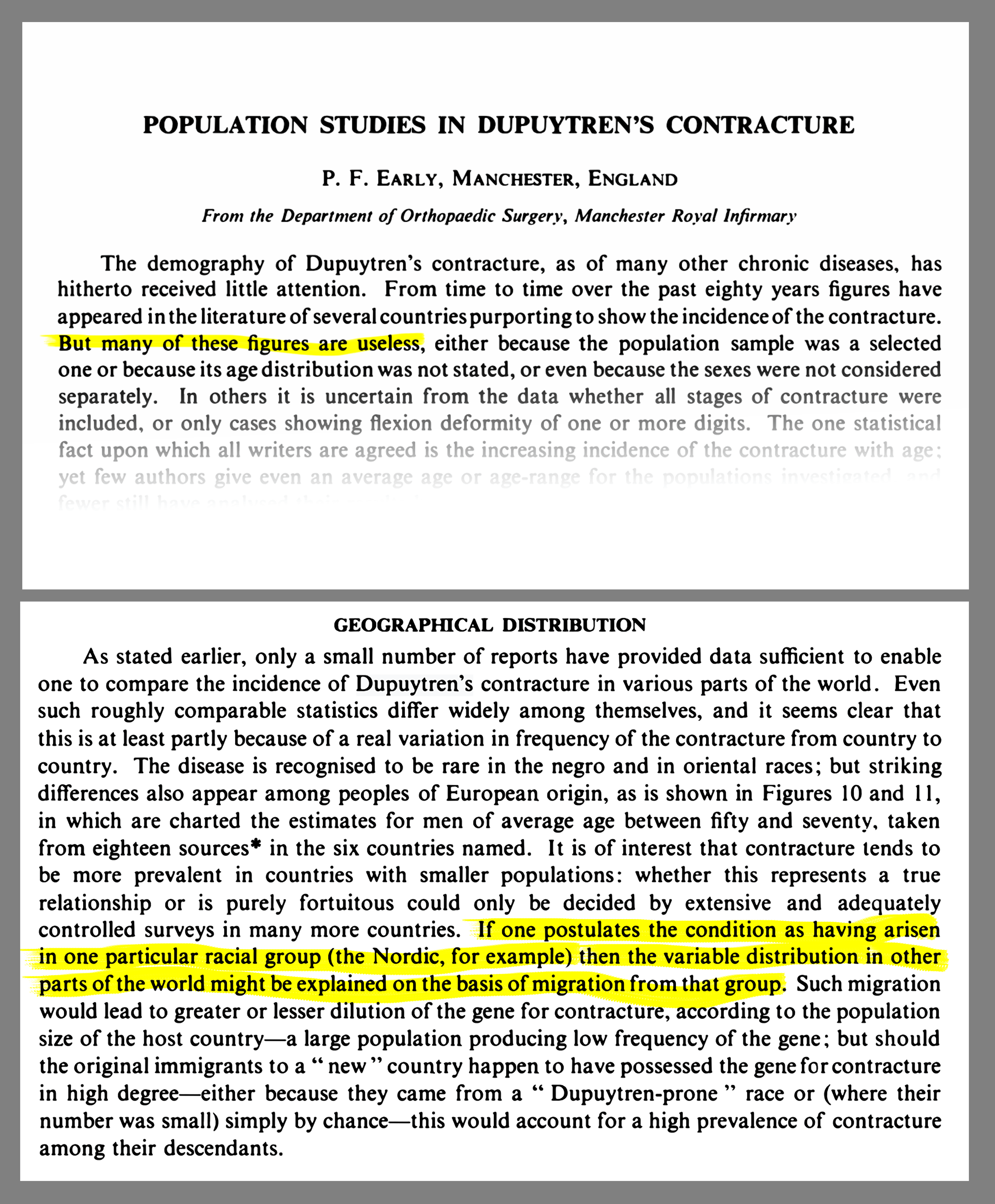
In his own words, “If one postulates the condition as having arisen in one particular racial group (the Nordic, for example) then the variable distribution in other parts of the world might be explained on the basis of migration from that group.”
Not only did this speculation rest on the same sparse and incomparable international prevalence data that he had just spent pages criticising, but it was remarkably difficult to test. If an imagined Nordic source population could be diluted to any degree by migration and admixture, then almost any geographical pattern might be accommodated after the fact. The hypothesis became elastic enough to explain whatever prevalence happened to be observed. Why Early chose to include this speculation is impossible to know. Perhaps it reflected ideas about the disease’s origins that were circulating among British surgeons at the time. If so, he left us no clue.
But how did Early’s vague “Nordic” source population become so firmly established as a “Viking” one?
Unfortunately the transformation is contained in a book chapter that seems to be as rare as hen’s teeth. We have the reference; Hueston, J.T. (1985) ‘Overview of aetiology and pathology’, in Hueston, J.T. and Tubiana, R. (eds) Dupuytren’s Disease. 2nd edn. Edinburgh: Churchill Livingstone, p. 75.
We even have the exact line: “That the Celtic immigration has spread this ‘Viking disease’ across the north of Europe, where the highest incidence is in Iceland, but that in Sweden is matched in Edinburgh and the centres of British migration such as Canada and Australia, still demonstrates the Viking invasions as the most decisive factor in the distribution of this condition.”
I have failed again and again to put my hands on a pdf of this chapter so that I can get some context, but for now, I have to settle for that lone sentence. How do I know that this is the origin myth laid bare? I don’t, not for sure, but I have burned many a midnight candle hunting down the source of the myth, and I am prepared to guarantee that J.T. Heuston is our culprit, and this is the chapter in which the myth was born.
When the second edition of Dupuytren’s Disease appeared in 1985, John Turner Hueston was without question the senior Australian authority on Dupuytren’s disease, with towering international stature in his field. He was approaching the end of his active surgical career. He had become a well-respected, world-renowned consultant plastic surgeon at the Royal Melbourne Hospital in Victoria, and had published frequently on the disease both as sole author and with the other doyens of the disease. He had published an authoritative and hugely influential monograph Dupuytren’s Contracture in 1963, delivered the Hunterian Lecture on the disease in 1964, and had accumulated decades of clinical experience by the time he edited his 1985 volume with Raoul Tubiana.
But that line, “That the Celtic immigration has spread this ‘Viking disease’ across the north of Europe…” was not written by a Scandinavian with extensive experience of the disease in Norway or Sweden or Denmark, nor was it written by a geneticist or epidemiologist, nor by a historian of migration. It was written by an Australian hand surgeon whose expertise, undoubted and respected, was uniquely clinical and surgical.
In 1985 there were no population-genetic data capable of testing Viking versus Celtic versus any other hypotheses about putative northern European ancestry. Hueston’s statement cannot be a conclusion derived from evidence. The wording , “…demonstrates the Viking invasions as the most decisive factor…”, is a strong, almost binary, assertion that today would not pass peer review in an epidemiological paper without overwhelmingly convincing supporting evidence. Hueston could not possibly have been in a position to provide that evidence. “The highest incidence is in Iceland”, he stated, and went on, “but that in Sweden is matched in Edinburgh and the centres of British migration such as Canada and Australia”. Where did he get that information, and how did he know it was valid?
I would be very interested to see the surrounding pages (75–81) of the chapter. Hueston may have been presenting an argument, reviewing competing hypotheses, or possibly summarising earlier ideas. Without the surrounding text it is difficult to judge the evidential basis for that sentence. But knowing who Hueston was, this was a clinical surgeon’s firm pseudo-historical opinion formed from extremely shaky premises, and not a conclusion supported by the genetic and demographic evidence that would be demanded today. He was mansplaining, or perhaps even surgeonsplaining.
Nearly sixty years after Early’s publication, Nader Salari and his colleagues assembled what is probably the most comprehensive collection of prevalence data yet published: 85 studies involving more than 6.6 million people from Asia, Europe, Africa and the Americas. Their meta-analysis produced a pooled prevalence estimate of 8.2%. Their Table 1, however, demonstrates that the prevalence of Dupuytren’s disease is highly dependent on who is studied, how cases are identified, and the age and health characteristics of the sub-set of the population from which the sample is drawn. Prevalences reported in the table range from 0.03% to 84%; clearly there is no single meaningful prevalence applicable to all populations. Their 8.2% global prevalence is, as we say in my neck of the woods, horse apples. (I think the analysis provided by the authors of the paper is dreadful. But I think their table, part of which I reproduce here, represents the state of play faithfully and is the best, or at least the most convenient, summary of the data that we have.)
Thefollowing data are extracted from Table 1 in Salari et al. I have limited the extract to entries relating to Europe. These data here is to show the wild heterogeneity of the estimates of prevalence. I have not reproduced many of the columns in the original table, including age, which is extremely confusing, but which merits study, and the one that allows the reader to track down the paper from which the data come.
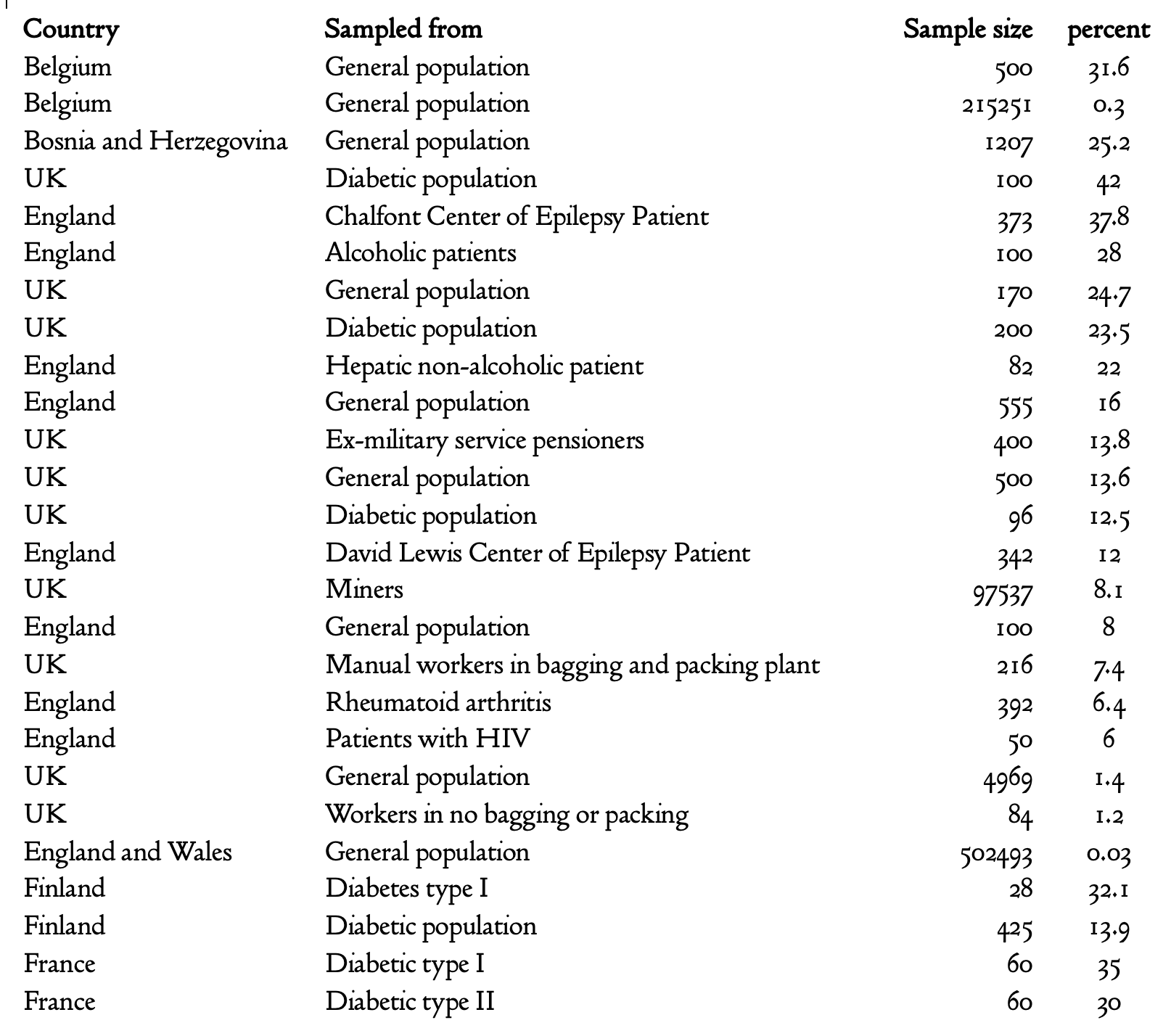
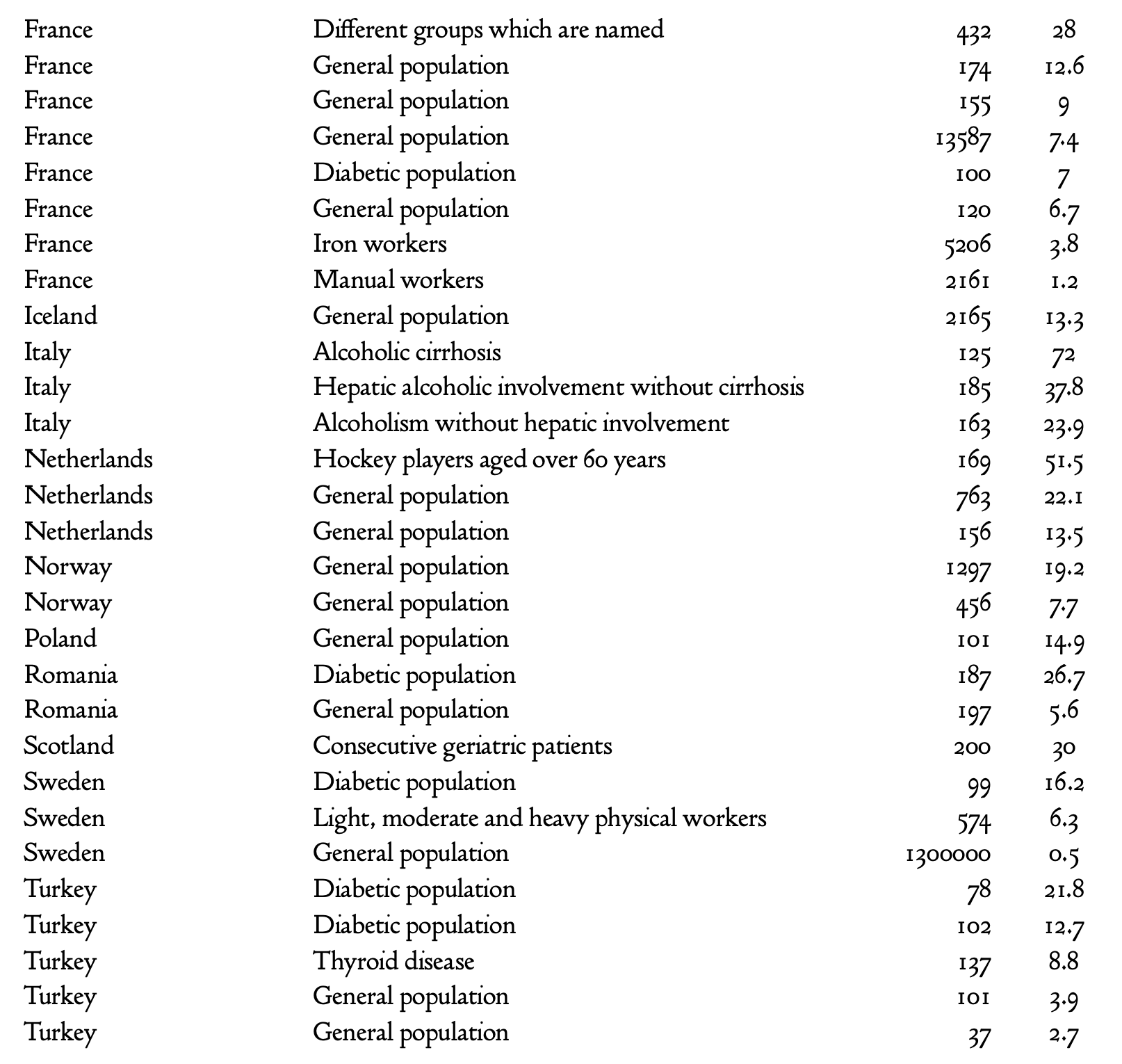
We know from many sources that Dupuytren’s disease becomes more prevalent with age. Male sex is also a strong risk indicator, but age is probably the dominant determinant of observed prevalence in most population studies. This creates a major problem when comparing the studies assembled in Salari’s Table 1. Some studies recorded in that table included anyone of adult age, others only people over 40, 50, or 60, some report work within age bands, while still others tell us a mean age of the people studied, or provide no age information at all. These methodological differences have a direct impact on epistemology because they alter the expected prevalence mechanically, which, even if the underlying biology were identical from study to study, would scramble the information into mayonnaise.
A study restricted to people over 60 would be expected to report a much higher prevalence than a study including everyone over 18, simply because it contains a larger proportion of people who have lived long enough to develop the disease. Consequently, differences in reported prevalence may tell us more about the age structure of the sample than about the frequency of the disease in the population from which it was drawn.
This means that the prevalence estimates in Table 1 cannot be interpreted. Without age standardisation, or at least age-specific prevalence estimates, it is impossible to know how much of the variation between studies reflects biological differences and how much is an artefact of who was included in the sample. The age distributions are so different in this table that this alone puts comparisons between countries out of the question. For Dupuytren’s, an age-dependent disease, prevalence is not a simple property of a country, ethnicity, or population. It is a property of a population observed through a particular age window. Unless those windows are made comparable, differences in prevalence are likely to be more demographical than biological.
The problem is compounded by the fact that age is entangled with other variables. Cohorts differ not only in age but also in occupational history, diabetes prevalence, alcohol exposure, smoking history, survival effects, and access to healthcare.
Moreover, many of the studies recorded in the table were not intended to estimate prevalence in the general population at all. Instead, the researchers sampled people whom they had selected on the basis of characteristics already believed to influence the likelihood of Dupuytren’s disease. They sampled groups of diabetics, alcoholics, miners, manual workers; they sampled people hospitalised with epilepsy, haemochromatosis, or psoriasis. The resulting prevalence estimates therefore reflect very different prior expectations about disease frequency from one group to the next and can not possibly be interpreted as estimates of prevalence in the broader populations from which they were drawn.
In fact, Table 1 offers no possibility of country-to-country comparisons. The Belgian study, of people aged over 50 who researchers approached in municipal markets in Flanders, reports 31.6%. The Swedish study, which uses cases of the disease diagnosed by doctors and extracted from a database of 1.3 million people, reports 0.5%. Those numbers tell us nothing about whether Dupuytren’s is more common in Belgium than Sweden. They tell us something – though it is perhaps not quite clear what – about the consequences of using different study populations, disease definitions, and methods.
The table does at least shows that the disease is not confined to northern European populations. But these studies are not enough to say confidently that prevalence is in any way common across Asia; and the single African estimate is uninterpretable.
Diabetic cohorts repeatedly show higher prevalences than corresponding general populations. Alcohol-related cohorts also show markedly elevated prevalences.
The large administrative database studies generally report low prevalences, often below 1%, possibly implying that many people with Dupuytren’s disease are never diagnosed – or if diagnosed, that their data never enter administrative healthcare records – or possibly, just that there is a strong association of the disease with age and if you include lots of young people in your sample set, you will reduce your estimate of prevalence.
It is very obvious that the studies are not measuring the same thing. These various measures lead to estimates that can differ by an order of magnitude, and that simply can not be compared. The extreme heterogeneity reported by the authors (I² = 99.9%) could not be clearer. These studies are not estimating a single underlying prevalence. All we have in this table – and I stress that these are the best data on prevalence that we have access to – are prevalences in groups of people selected for different reasons under different definitions and using different methods.
The only reasonably robust conclusion is that Dupuytren’s disease is a common disorder of older adults of Northern European ancestry, strongly associated with age and several comorbid conditions, probably substantially underdiagnosed in routine healthcare data, and that the data are still far too heterogeneous for a single global prevalence figure to have any biological meaning.
The similarity between Early and Salari is instructive. Early had relatively few data but a clear appreciation of the methodological difficulties. Salari had vastly more data but demonstrated that the problem remains intact. The studies do not measure a single quantity. They differ in age structure, sex composition, ancestry, case definition, ascertainment method, and whether they examine the general population or selected clinical groups. As a result, there is still no single prevalence figure that adequately describes Dupuytren’s disease in any single country, far less any that allows us to compare countries. And there is still no evidence whatsoever that the disease had anything to do with Vikings.
What is more, despite what Hueston might have imagined, “Viking” is not like “Maasai”. It is not an ethnolinguistic population. Maasai speak Maa, and they have a cultural tradition, a historical continuity, a territory, and a degree of shared ancestry that makes it meaningful to speak about the genetics of the Maasai population, even though Maasai people are not genetically identical and have intermarried with neighbouring groups. If a genetic variant were found to be unusually common among the Maasai, one could sensibly say: “This variant occurs at a high frequency in the Maasai population.” One could then investigate migration, founder effects, drift, selection, and admixture. By contrast, saying, “This variant originated in the Vikings” is rather like saying “This variant originated in pirates.”
Because “Viking” is a word for pirate, trader, seafarer, or perhaps migrant. It is a role, activity, or cultural-historical category into which people of varied ancestry could enter. The Old Norse phrase fara í víking meant something like “to go raiding” or “to go on an expedition”. Many of the people later called Vikings came from areas that are now in Norway, Denmark or Sweden, and spoke Norse dialects. Viking-age Scandinavian societies were not genetically homogeneous. Ancient DNA shows structure within Scandinavia itself, gene flow into Scandinavia, and different Scandinavian ancestries moving into different regions. Viking-age networks also included slaves, captives, spouses, craftsmen, mercenaries and locally assimilated people. In their ships, they carried weapons, law, language, myth and trade practices; they did not carry a single “Viking genome”. Blaming Dupuytren’s disease on “the Vikings” therefore mistakes a loose historical category for a coherent biological population. If one is going to blame Vikings for Dupuytren’s disease one might, with almost equal absence of justification, blame Sjögren’s syndrome on Californian dentists.
What can be said with confidence is that Dupuytren’s disease is common, strongly age-related, more frequent in men than women of the same age, associated with several medical conditions including diabetes, and substantially under-recognised in routine healthcare records. The prevalence in comparable populations across different regions and ancestries is still completely unknown. In that respect, the central lesson of Early’s 1962 paper remains valid today. We cannot compare prevalence figures unless we first compare what was measured, in whom, and how.
Dupuytren’s disease is not unique to northern Europeans, but the prevalence data are too heterogeneous to determine whether it is more common in some ancestral populations than others. The data in Salari’s table do not even confirm that Dupuytren’s is intrinsically more prevalent in northern European lineages. It probably is; the better population studies have all been carried out in northern European countries where researchers expected the disease to be common, and doctors there had encountered the disease enough to think it worth studying. But it does not establish the size of the difference between northern Europe and other regions, nor does it identify ancestry as the cause.
There is no possible way to detect the twisted ghostly fingers of Vikings in these data.
While we cannot say whether the disease is more common in some ancestral populations than others, we know without doubt that heredity is important. Dozens of associated genetic variants have now been identified, some of which appear to have entered the genomes of modern humans through admixture with Neanderthals tens of thousands of years ago. The genetics have advanced dramatically; the epidemiology has not.
We cannot answer the question that Early posed in Manchester in 1962: how common is the disease?
Early, P.F. (1962) ‘Population studies in Dupuytren’s contracture’, Journal of Bone & Joint Surgery, British Volume, 44(3), pp. 602–613.
Salari, N. et al. (2020) ‘The worldwide prevalence of the Dupuytren disease: a comprehensive systematic review and meta-analysis’, Journal of Orthopaedic Surgery and Research, 15(1), p. 495. Available at: https://doi.org/10.1186/s13018-020-01999-7.
Here are some papers referring to observations of Dupuytren’s disease outside Europe.
Chow, S.P., Luk, K.D. & Kung, T.M., 1984. Dupuytren’s contracture in Chinese: a report of three cases. Journal of the Royal College of Surgeons of Edinburgh, 29(1), pp.49–51. — Three ethnically Chinese patients in Hong Kong; clinical pictures typical of DD.
Liu, Y. & Chen, W.Y., 1991. Dupuytren’s disease among the Chinese in Taiwan. Journal of Hand Surgery (American Volume), 16(5), pp.779–786. — Hospital-based series from Taiwan describing DD in ethnic Chinese; establishes that DD occurs in this population and outlines clinical features and management.
Park, M.S., Seo, Y.S., Rah, S.K. & Choi, C.U., 1991. A clinical study of Dupuytren contracture. Journal of the Korean Orthopaedic Association, 26(1), pp.239–246. — Nine cases (seven patients) treated 1985–1990; all male; typical ulnar-digit pattern; operative outcomes reported.
Kang, E.S. & Kim, H.J., 1986. Dupuytren’s contracture: report of 12 cases. Journal of the Korean Orthopaedic Association, 21(2), pp.347–352. — Twelve cases (eight patients); early Korean experience; details of surgical treatment and follow-up.
Vathana, P., Setpakdi, A. & Srimongkol, T., 1990. Dupuytren’s contracture in Thailand: A review of nine cases. Bulletin of the Hospital for Joint Diseases Orthopaedic Institute, 50(1), pp.41–47. — Nine Thai cases; adds Southeast-Asian data point with standard clinical presentation.
Bozhanina, B.M. & Popstefanov, R.D., 2016. Dupuytren’s contracture in a patient from Vietnam: a case report. Scripta Scientifica Medica, 48(2), p.63. — Single Vietnamese case; confirms occurrence in mainland Southeast Asia.
Evangelista, T.M.P., 2022. Dupuytren’s contracture in a Filipino male: a case report and review of the literature. Journal of Medicine, University of Santo Tomas, 6(1), e2020–0080. — Filipino case with concise regional literature review (East/Southeast Asia).
Pai, C.-H. & Tseng, C.-H., 1994. Dupuytren’s contracture: report of a Taiwanese case. Journal of the Formosan Medical Association, 93(8), pp.724–726. — Additional Taiwanese case report reinforcing presence of DD in ethnic Chinese.
South Asia
Srivastava, S., Nancarrow, J.D. & Cort, D.F., 1989. Dupuytren’s disease in patients from the Indian sub-continent: report of ten cases. Journal of Hand Surgery (British Volume), 14(1), pp.32–34. — Ten operated cases in UK residents of Indian origin; phenotype comparable to Caucasian patients.
Middle East
Stahl, S. & Calif, E., 2008. Dupuytren’s palmar contracture in women. Israel Medical Association Journal, 10, pp.445–447. — Female-only series from a northern Israel hand unit; demographic breakdown includes Ashkenazi, Sephardi/Mizrahi and Arab patients, showing DD across Israeli communities.
Al-Qattan, M.M., 2000. Dupuytren’s disease in Saudi Arabia. Canadian Journal of Plastic Surgery, 8(5), (pages not listed online). — Prospective screening of 600 consecutive adult Saudis; 2 cases identified (~0.3%), indicating rarity in this setting.
Africa
Furnas, D.W., 1979. Dupuytren’s contractures in a black patient in East Africa. Plastic and Reconstructive Surgery, 64(2), pp.250–251. — Early East-African case letter; documents DD in a person of African descent in Ethiopia.
Muguti, G.I. & Appelt, B., 1993. Dupuytren’s contracture in black Zimbabweans. Central African Journal of Medicine, 39(6), pp.129–132. — Four Zimbabwean patients; clinical features and management discussed.
Richard-Kadio, M. et al., 1990. [Dupuytren’s contracture: review of the literature. Case report of a black African]. Médecine Tropicale (Marseille), 50(3), pp.311–313. — Ivorian case report with literature review; frames DD as rare but present in West Africa.
Richard-Kadio, M., Yeo, S., Kossoko, H. et al., 2008. [Dupuytren’s contracture: a report of three cases in Black Africans]. Chirurgie de la Main, 27(1), pp.40–42. — Trio of Ivorian cases; strengthens West-African documentation.
Sefeane, T.I. & Mwangi, P.N., 2017. Incidence of Dupuytren’s disease in Africans: a report of 48 new cases and a literature review. SA Orthopaedic Journal, 16(2), article a6. — Surgical series from a major Soweto unit (1997–2015); 48 black African patients; includes a cautious review of prior reports and ethnicity ascertainment.
Gebereegziabher, D., Kassa, A., Ayele, A. & Taye, A., 2017. Dupuytren’s contracture in Ethiopia. Journal of Hand Surgery (European Volume), 42(1), pp.26–28. — Case report/short series highlighting occurrence in Ethiopia.
North America (non-European ancestry focused)
Makhlouf, M.V., Cabbabe, E.B. & Shively, R.E., 1987. Dupuytren’s disease in blacks. Annals of Plastic Surgery, 19(4), pp.334–336. — U.S. surgical series describing DD in black patients; counters the “exclusively Northern-European” trope.
Gonzalez, M.H., Sobeski, J., Grindel, S., Chunprapaph, B. & Weinzweig, N., 1998. Dupuytren’s disease in African-Americans. Journal of Hand Surgery (British Volume), 23(3), pp.306–307. — Short series of African-American patients with DD.