National Security and the Misuse of Science
Ecology, uncertainty, and the language of collapse

The UK Government’s assessment “Global biodiversity loss, ecosystem collapse and national security” applies intelligence-style uncertainty frameworks and reasonable–worst-case reasoning to ecological change.
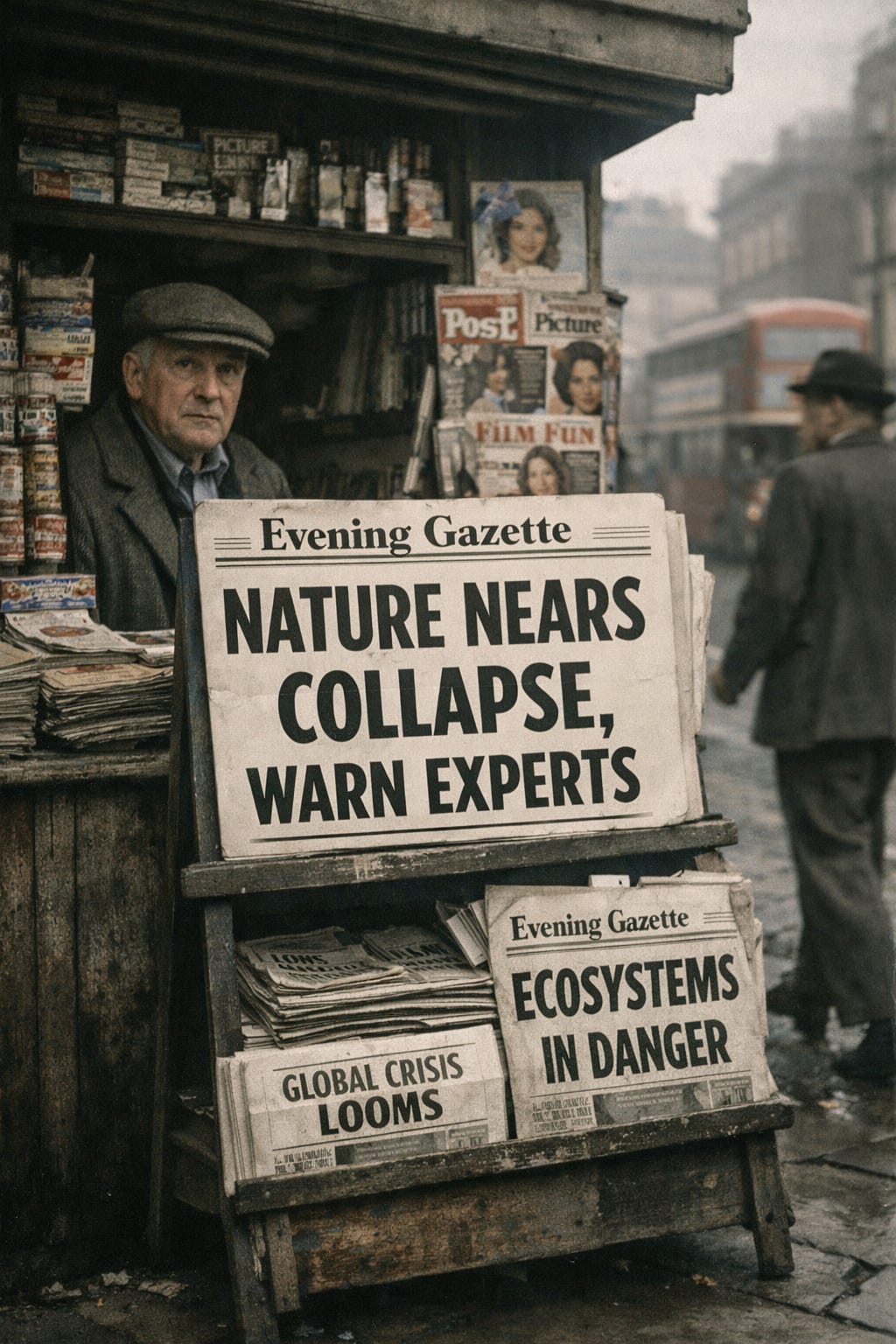
From the authors’ perspective, the assessment is not intended as a contribution to ecological theory but as a strategic national-security warning document. Its use of concepts such as “ecosystem collapse”, “pathways”, “tipping points”, and planetary boundaries is deliberately schematic. They aggregate heterogeneous ecological stresses into a form that security planners, accustomed to dealing with deep uncertainty, sparse data, and high-impact risks, will find legible. The emphasis on worst-case trajectories, irreversibility, and cascading effects reflects a precautionary stance. The authors clearly judge that, even in the absence of precise thresholds, trajectories, or timings, the convergence of biodiversity loss, climate stress, and global interdependence plausibly increases the probability of systemic disruption at scales relevant to national security. Demanding ecological precision comparable to that of disciplinary science would miss the purpose of the exercise, which is to signal risk under uncertainty and to motivate anticipatory policy.
It is not a scientific report, but even granted this framing, it stretches and generalises ecological concepts and makes claims it cannot support on the evidence and methods it presents. I sympathise entirely with the underlying concern that continued ecological degradation driven by human activity is likely to generate serious social and political consequences at large scales. My objection is not to that message, but to the way scientific concepts are stretched to support it, and to the loss of credibility and erosion of trust that follow when alarm substitutes for analysis, and warning is repeatedly framed as inevitability. National security planning should not rest on polemic, however well intentioned.
The idea of “ecosystem collapse” sits at the centre of the document. It frames collapse as a driver of cascading geopolitical risk. It defines ecosystem collapse early on as an irreversible loss of structure or function that occurs once a critical threshold is crossed. But the document invokes this “critical threshold” without specifying any defined state variable, modelled dynamic, or measurable ecological property. The term can therefore only function rhetorically, as a somewhat mystical marker of irreversible change, because without referents it simply cannot function analytically. The document does not identify what would constitute crossing such a threshold, or how this could be assessed across fundamentally different systems. It then applies the concept across continents, biomes, and decades. “Every critical ecosystem is on a pathway to collapse,” it says, offering timelines (2030 for coral reefs and boreal forests, 2050 for rainforests and mangroves).
This language is rhetorically powerful but scientifically weak. Outside a small number of tightly studied cases, ecology does not support claims of collapse, and certainly not at the scales used here. The evidence base is heterogeneous and system-specific; the report lifts the strongest “critical transition” framing found in some synthetic reports and then applies it as if it were a general property across very different systems and response variables, without specifying metrics or comparability. The literature documents degradation, reorganisation, or loss of particular functions, but it does not, except in some very specific cases, document wholesale or irreversible failure of entire ecosystems. Ecosystems change, and as they change, some processes fail, others persist, new configurations emerge. The result may not be an ecosystem that we want, but it is still an ecosystem. “Collapse” is a dramatic metaphor but it is not a general endpoint. A policy document like this should be more clinically discriminatory, and less frankly alarmist.
If “every critical ecosystem is on a pathway to collapse,” what is a “critical ecosystem”? The report defines ecosystem in the standard ecological sense and announces an intention to identify “critical ecosystems of concern for the UK”, but it never defines critical ecosystem as an ecological category. Instead, the report identifies Geographic Regions of strategic Ecological Importance for the UK (GeoREI-UK). These are regions whose boundaries are drawn to include ecosystems or ecoregions exhibiting at least 3 of 5 ecological, social, and economic “features of concern” - these features being scale of impact, speed of collapse, intactness, irrecoverable carbon, and degradation to quality of life. The document then treats these constructed regions, and the disparate ecosystems within them, as if they were commensurable ecological entities following comparable pathways to collapse.
The logic is circular: first we identify regions as being “of concern” on the basis of impact-weighted criteria, and then present them as “critical ecosystems” on pathways to collapse. The report offers no independent ecological analysis that would distinguish concern from collapse.
I cannot move on without remarking that the report treats five incommensurable “features of concern” (scale of impact, speed of collapse, intactness, irrecoverable carbon, and degradation to quality of life) as if they could be combined into a single screening rule. These are not quantities in a shared space: they mix biophysical stocks, ecological condition, time-to-event claims, and explicitly social and normative considerations. Even in principle, combining such features into an index requires a defensible account of commensurability. In practice, it would also require defined metrics, units, normalisation, and explicit weights. The report supplies none of this. One is left wondering in what units any of these features are measured, and how a “three-out-of-five” rule is meant to be interpreted.
This difficulty is a direct consequence of non-commensurability. In the absence of shared metrics, units, or scales, the assessment relies on a binary decision structure, treating each “feature of concern” as either present or absent and then flagging regions through a “three-out-of-five” co-occurrence rule. But none of the five features of concern is binary; all are continuous. For each, a threshold would therefore have to be stipulated to allow inclusion or exclusion in the “three-out-of-five”.
Establishing such a binary classification would require, first, that a scale and reference framework be specified for the feature and that a threshold on that scale be defined. It would then require that each expert be able to assess values on that scale consistently across regions, even if different experts assign different values. Finally, it would require a transparent and repeatable rule for using the resulting distribution of values to determine whether a given region lies above or below the stipulated threshold. None of these conditions is specified or defended in the assessment. In their absence, the binary classification is not evidence of a stable or well-defined property that could sustain repeatable assessment or confidence claims.
Examining the “features of concern” makes clear why none of them admits of the kind of scaling, thresholding, and classification the method requires.
“Irrecoverable carbon” has meaning only relative to specified time horizons, assumptions about future technological trajectories, and policy choices.
“Quality of life” is explicitly normative, multidimensional, and scale-dependent, and does not denote a property of large geographic regions in any coherent sense. At the spatial scale of the GeoREI regions, any conceivable indicator would necessarily aggregate radically different living conditions and social positions. No unitary measure of “quality of life” can meaningfully combine the circumstances of thousands living in informal settlements with those of affluent populations elsewhere in the same region.
“Speed of collapse” embeds a self-referential category error: it assumes what it is meant to help establish. It presupposes that “collapse” is a well-defined and determinate attractor in a notional state space, that movement toward it is already underway, and that a meaningful derivative ds/dt can be defined. Assigning any such speed would require a defined endpoint, a metric of distance through a specified state space, and omniscient knowledge of how rapidly the system is moving through that space and of which trajectories will in fact be realised. In the absence of an explicit model of system dynamics, drivers, and feedbacks, and without access to the counterfactual futures against which ‘speed’ would have to be assessed, there is no coherent basis on which experts could assign a value to this feature.
“Intactness” supposes a normative, implicitly pristine, reference state that has no historical instantiation given long histories of human modification, climatic variability, and ecological reorganisation. Experts are therefore asked to assess deviation, without defined units, from an idealised construct that can only possibly exist in their minds, rather than from an empirically instantiated ecological condition.
“Scale of impact” is the least well-defined of these five poorly defined features. It does not correspond to a coherent variable, or even to a coherent class of variables, and the report does not specify what the impact in question is impact on. At different points it appears to refer to biophysical effects on ecosystems, consequences for human populations, economic disruption, political salience, or geopolitical sensitivity. Spatial extent, number of people affected, ecological change, economic significance, and political response are incommensurable and do not vary along a single axis. They may be correlated or independent, orthogonal or interacting, and in some cases linked by reinforcing or damping feedbacks. A small biophysical perturbation can have large political consequences; a large ecological change may have limited social impact; effects may be intense but local, diffuse but widespread, immediate or delayed. Framing assumptions therefore determine both what counts as impact and how its scale is judged. There is no principled sense in which “scale of impact” can be assessed as present or absent, nor any stable ordering by which one case could be judged larger or smaller than another.
Expert elicitation cannot impose a Boolean decision logic on phenomena whose ontology is continuous, relational, and future-contingent. Yet this is what the assessment does.
A further difficulty concerns the stability and repeatability of the decision rule itself. The choice of a “three-out-of-five” threshold is neither derived from theory nor justified by reference to sensitivity, error rates, or robustness. It sits uncomfortably between an analytic criterion and an exploratory heuristic. Because the underlying features lack defined thresholds, and because expert judgements are neither anchored to shared metrics nor accompanied by uncertainty bounds, there is no reason to expect the same regions to be selected if the exercise were repeated with a different panel, at a different time, or under slightly altered framings of the same evidence. Small shifts in interpretation could readily flip a feature from “present” to “absent”, moving a region across the threshold without any substantive change in the underlying systems. The procedure therefore lacks invariance under perturbation: it is not clear what, if anything, is preserved across runs of the assessment. Nothing in the assessment is offered that would warrant rejecting the null hypothesis that the method is inherently unrepeatable.
In the fashion of the IPCC and the IPBES, the report gives “High” analytical confidence to its judgement that “Every critical ecosystem is on a pathway to collapse (irreversible loss of function beyond repair)”. If we are to take seriously the notion of a “pathway to collapse”, then how are we to reconcile this “High” confidence with the simultaneously declared “Low” confidence in “the exact timing and pathways of critical ecosystem collapse”?
(I feel I should perhaps explain my exasperation with this apparent quantification of certainty. Ontologically, there is nothing in the world that corresponds to “High confidence”. Epistemologically, it is unclear what would make such a judgement true or false, or how it could be independently tested. The IPCC/IPBES confidence framework looks quantitative, but it isn’t. The labels “High”, “Medium” and “Low” are not probabilities, not frequencies, not derived from a model, and not anchored to a defined evidential metric. They are consensus judgements produced by deliberation among experts, combining heterogeneous evidence, different kinds of uncertainty, and value-laden assessments of plausibility and risk. In many IPCC contexts, this ritualised confidence assignment is at least attached to specific physical relationships, explicit model ensembles, or well-defined empirical trends. None of this anchoring is present in the IPBES reports, and in this UK report the confidence label is attached to a claim that is conceptually vague (“pathway to collapse”), ontologically under-specified (collapse of what, measured how), and methodologically unsupported (no trajectory, no threshold, no state space). The confidence grading creates the appearance of solidity where none has been established. The confidence grading functions performatively, conferring authority without providing epistemic warrant.)
Revenons à nos moutons. The report (a) asserts an outcome, and (b) frames that outcome in terms of a pathway. A pathway implies a directional process and a trajectory through some notional state space, and we might therefore expect some basis for judging whether a system is on that trajectory or elsewhere. To say with high confidence that all critical ecosystems are on such pathways necessarily requires high confidence in the existence and character of those pathways. It is difficult to assert with great confidence that “I am on a pathway to Stockholm” if I do not in fact have a clue whether I am on a footpath in Finland, on horseback in Patagonia, somewhere on the E4, or on a flightpath at 30,000 feet over the North Sea.
If “pathway” is intended as an analytical concept, confidence in being on a pathway cannot greatly exceed confidence in what that pathway consists of. If, on the other hand, “pathway” is a rhetorical device to signal concern or direction of travel rather than a defined trajectory, then attaching any “scientific” confidence label to it necessarily misleads.
The report designates GeoREI regions by operationalising “critical ecosystems” through the co-occurrence of five “features of concern” (scale, speed, intactness, irrecoverable carbon, and “degradation to quality of life”) and expert voting. It therefore claims a method for selecting regions, but no corresponding method for assessing “distance along a pathway to collapse”. For the Amazon, the report quotes a specific (and contested) threshold range (20–25% deforestation under warming and fire; “currently at 17%”). Even here, the threshold is explicitly conditional and model-dependent. The report provides no analogous threshold logic for the other named systems, yet still speaks in a single register (“collapse”) across all of them.
The document makes expansive use of “critical threshold or tipping point … transitions irreversibly from one stable state to another”, and claims that concurrent collapses arise from “shared drivers and feedback loops” as if shared drivers implied shared dynamics. Tipping points do exist in some ecological systems under specific conditions, but they are not generic properties of ecosystems. They depend on well-characterised feedback mechanisms and clearly defined state variables. Even where tipping points are plausible, thresholds are uncertain, system-specific, and conditional on particular combinations of drivers, scales, and response variables. In this assessment, tipping points are not treated as hypotheses to be tested, but instead function as a narrative device implying sudden and unavoidable change. That framing encourages a view of ecological futures as synchronised and catastrophic, when heterogeneity and contingency are far more probable.
The claim that “every critical ecosystem is on a pathway to collapse” illustrates the problem. A pathway implies direction, distance, and an identifiable endpoint. None of these are specified. There is no defined state space, no metric of proximity to collapse, and no principled way to compare the supposed pathways of coral reefs, boreal forests, mangroves, and the Himalayas – systems that, I hardly need point out, are governed by entirely different dynamics, feedbacks, and response times. Here, “pathway” signals concern, but it does not describe a measurable trajectory. Again, for policy, it is important to distinguish clearly between scientific understanding and rhetoric.
The document notes that several “planetary boundaries” have been “crossed”, with an implied proximity to collapse. It describes planetary boundaries as “safe limits identified by scientists” and then claims that “six boundaries have been crossed”, with an implied escalation of danger. Yet the science underlying the planetary boundaries framework explicitly treats these boundaries as normative, policy-relevant risk thresholds, not as indicators of system failure. Even if we treat planetary-boundary variables as purely biogeophysical state variables governed by well-understood physical or chemical relationships, this does not imply the existence of thresholds or deterministic transition points. These systems respond continuously, with risk accumulating rather than failure occurring at any specific point. The boundaries themselves are therefore not properties of the Earth system, but precautionary markers chosen for policy purposes. Crossing a boundary does not mean a system is failing; it means that a measure of the system concerned lies outside the broad conditions of the Holocene. Presenting boundaries as reified limits rather than risk indicators greatly distorts what the science says.
More seriously, even the claim that planetary-boundary variables are governed by physical or chemical relationships rests on a drastic abstraction. It is only defensible if human behaviour is treated as fixed or exogenous. In the world we actually live in, human societies are not a small perturbation to Earth-system dynamics; they are the primary drivers of change in every planetary-boundary variable. The assessment itself treats mass migration, social instability, and geopolitical conflict as central consequences of ecological change, yet in its treatment of planetary boundaries it describes system behaviour as if it were governed primarily by biophysical processes. This brackets out the same social and political dynamics that the document elsewhere identifies as decisive, reducing a coupled socio-ecological system to an abstract Earth system devoid of agency. Methodological cherry-picking of this kind, treating causes as biogeophysical while treating consequences as social and political, is incoherent in a policy brief that relies on alarm about precisely those social and political outcomes.
Biodiversity loss undoubtedly poses serious risks to food systems, markets, public health, and geopolitical stability. The assessment is strongest where it stays close to those dependencies: the UK’s reliance on imports, the vulnerability of global supply chains, and the way ecological stress interacts with political response. But it should not allow ecological language, especially language that goes well beyond what can be operationalised or monitored, to be forced to carry the weight of security rhetoric. Scientific precaution is not prediction. Degradation is not collapse, and uncertain ecological change is not some doom-laden trajectory.
There is a deeper conceptual problem with the language of “collapse” in this report. It conflates degradation, reorganisation, and loss of valued functions into a single endpoint claim that carries rhetorical force but little analytical clarity. That issue deserves separate treatment. For present purposes, it is enough to note that the assessment asks the concept to carry explanatory and predictive weight it cannot bear.
Overstated ecological claims get in the way of prioritisation because they make all risks appear existential. Their apparent inevitability makes it harder to see where adaptation and mitigation are feasible. They are also a hostage to fortune when predicted collapses fail to materialise on the implied timelines.
A more defensible assessment would have said less about collapse and more about which ecological functions are at risk, where, under what pressures, and with what scope for response. It would have treated tipping points, if it mentioned them at all, as system-specific hypotheses rather than general properties. It would have used planetary boundaries, if at all, as signposts of risk, not as physical limits. This would still justify urgent action, on grounds that ecology can sustain.
In national security analysis, worst-case thinking has its place. In ecological policy, precision matters just as much. Blurring the two does not strengthen the case for action; it weakens the epistemic foundations on which that action must rest.
To find the report: https://www.gov.uk/government/publications/nature-security-assessment-on-global-biodiversity-loss-ecosystem-collapse-and-national-security and click on “National security assessment on global ecosystems”
or search for “Global biodiversity loss, ecosystem collapse and national security”