Sinuous Paths through the Unknowable Web
Or, How Shit Happens

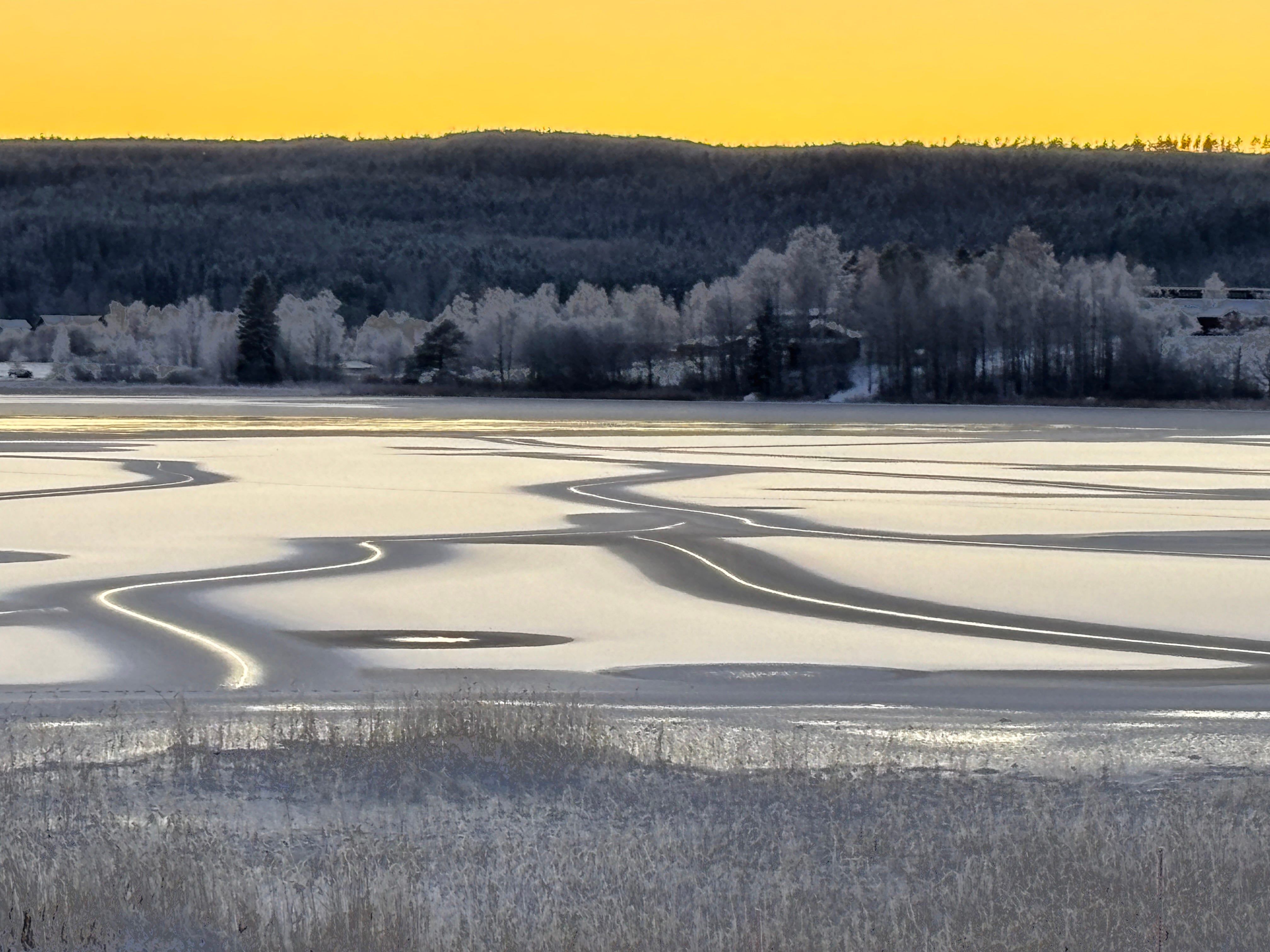
What caused these beautiful, sinuous patterns in the ice?
Well, the wind, of course.
Oh, and the temperature of the air and the water. And slight variations in the air temperature as the ice was forming. And the clear night sky on Tuesday that allowed for rapid radiative cooling, and maybe….
The more one tries to specify the cause, the more the list of possible influences expands, and the less any single factor seems like a reasonable explanation for these patterns.
That’s because events do not arise from neat A → B relations but from the alignment of countless conditions, processes, histories and constraints. Once we pay attention, the idea of isolating a cause for anything is clearly problematic. And this difficulty is not confined to ice patterns: it applies to every footfall, every firing synapse, every thought, every uneventful afternoon, and the Great War. It is the process of the world.
There are 5 or 6 major modern theories of causation. My unease with each of them is the same: to stay analytically tractable, each theory introduces a selection rule that functions as if there were a single preferred cause for every event. But at least in the world I inhabit (I have no solution to the problem of hard solipsism!) every event is the consequence of many contributing factors, most of them microscopic, most of them to a greater or lesser extent necessary, and many of them such that, had they been slightly different, the outcome would not have occurred in the way it did.
In systems governed by non-linear dynamics, sensitivity to initial conditions implies that what happens in our instance of the universe, as opposed to a near-identical neighbouring universe, does not lurk in the second decimal place, or even the millionth. A tiny difference in any contributing factor with the right couplings – say, the timing of a gust – could have changed the pattern in the ice, perhaps by a minuscule amount, but perhaps grossly. Every part of the evolving system is capable of nudging the outcome onto an alternative path. We see the final pattern as coherent and perhaps inevitable only because all those influences all did in practice (of course) align in one particular way. Viewed prospectively, nothing in the system guarantees that shape rather than countless others. What looks like a single effect is always the contingent product of innumerable interacting conditions, none of which has any claim to be the unique cause.
So then causation is saturated with overdetermination: countless factors are involved in producing even the most mundane event. Every event is deeply dependent on background conditions that we do not necessarily know and certainly cannot enumerate. Time’s asymmetry does not help; that the past is fixed and the future open does nothing to single out a privileged causal factor among the swarm of contributors.
What caused my kettle to boil at 12:07? The water had to be present; the wiring had to be intact; atmospheric pressure had to be within a narrow range; I had to notice I was thirsty, decide I was thirsty enough to lever myself out of my armchair, and in my confused mental state decide to make tea rather than coffee; I had to fill the kettle with water (just that amount, no more, no less) and press the switch at exactly the moment that would allow the kettle to reach boiling at exactly 12:07; and this list, while far from complete, is already over-long. Beneath this superficial list of causes lies a thicket of micro-interactions, thermal fluctuations, and – I feel I have to randomly name-drop something probably irrelevant here in the attempt to sound sciencey – quantum events. To ask for the cause is to ask for an arbitrary cut through an unbounded web of dependencies. What I decide was “the cause” of my kettle boiling at that moment is simply whichever piece of that web we decide matters for explanatory or practical purposes.
This need to simplify becomes formalised in some of the tools we use to depict systems.
Causal loop diagrams offer a beguilingly tidy picture of how complex systems behave. They compress the world into boxes and arrows, representing a system as a few well-defined stocks and flows. Each arrow implies a legible influence, positive or negative; each loop suggests that tangled dynamics can be reduced to a neat circuit on a page. The diagram seems to present itself as if it were depicting the system’s real structure – an ontology – rather than the preferences of whoever sketched it. But its apparent coherence comes entirely from what it omits. It slices through thousands of dependencies and retains only the few strands convenient to draw. The dense real-world tangle of non-linear interactions, delays, stochastic jolts and boundary conditions collapses into a cartoon in which A “leads to” B and B “feeds back” on A. As heuristics they have their place, but they foster the belief that causation is sparse and intelligible rather than saturated and distributed. They domesticate complexity by pretending it isn’t there.
Anyone teaching systems thinking will tell their students “first, define your system”. To call something “the system” is to decide which processes matter and which can be ignored. The system boundary of my freezing lake might be geographical, so the system consists of the water body and its overlying air. Or it might be thematic; I decide only to look at living organisms, or to exclude the influence of surrounding land use. My system might have temporal boundaries (between 1756 and 1873), or give shape to some other domain of investigation. While I may perhaps use some perceived border in nature (the edge of the forest) to determine what lies outside my system, nothing in nature marks that line from a causal perspective. It is a convenience for modelling. Causation is in fact distributed across everything in the lake’s light cone - that is to say everything that could, in principle, have had any influence on the present state of the system. Defining a system is a pragmatic way to make an intractable world tractable; it is not a discovery of where causes actually begin or end. A boundary is simply the point at which we stop listing influences.
Researchers who warn that correlation is not causation remind us that when things vary together they may both be responding to changes in a mesh of shared influences. In sciences where controlled experiments are possible, a pragmatic approach to multiple causalities is to discover how the system responds when one strand is isolated from the tangle of causality and all the other strands treated as background conditions. In the social sciences, researchers know that no social outcome has a single cause and that the tangle of influences can rarely be pulled apart. Since social life is so confusingly multi-causal, progress comes from recognising how several forces combine to give rise to observed outcomes.
A researcher may show a graph to show that changes in x cause changes in y. The subtext is that the correspondence holds provided that every other influence is held steady. The graph is the illustration of a pragmatic slice through a crowded field of dependencies, showing that x has a stable, detectable role in shaping y within the mesh of factors that also matter.
The sciences that handle the complexity of causes most successfully do so by treating causation as structural rather than singular. Climate modelling is a good example.
Climate models show how well a system can be understood without identifying any single cause. A model of global temperature does not privilege one driver; it represents the climate as the outcome of a dense interaction of a range of variables. These might include greenhouse gas emission rates, radiative transfer, ocean heat uptake, cloud physics, land use and orbital forcing. Or it could include a more sophisticated set of variables that includes, for example, sea-ice dynamics, soil-moisture processes and volcanic aerosols. These elements do not add up to a dominant cause. They provide a constrained dynamical system whose behaviour emerges from the mesh of influences. The predictive strength comes from capturing the structure and dynamics that arise when a large number of factors combine, cancel and amplify each other. The explanatory substance lies in the equations, the parameterisations, and the numerics. At this scale, distributed causation is not an obstacle to understanding; it is the condition that makes coherent modelling possible.
So where are we?
Every event is shaped by more contributing factors than we can name; each depends on a background we barely glimpse; and the one-way flow of time does nothing to pick out a privileged strand in the tangle. The past may be fixed and the future open, but neither helps us decide which of the many influences should count as the cause.
Philosophers have tried to make causation manageable by focusing on only a few of the many influences on an event. Counterfactual theories ask which factor the effect depended on, but in real situations any effect depends on many factors, and choosing one reflects context and interest. Interventionist theories define causes as things we can change, but that relies on human practices rather than any deep feature of nature. Mechanistic theories talk about entities and their activities, but even these mechanisms are carved up according to our modelling aims, so different descriptions isolate different “causes”. In all of these approaches, clarity comes from our simplifications, not by the world providing a single, natural line of causation.
The Swiss-cheese model of aviation upsets, which provides a metaphor for how catastrophic failures arise as the result of a concordance of circumstances, is also a reasonably good zeroth-approximation model, not just for air crashes, but for everything that happens. A sequence of tiny alignments and misalignments, holes and non-holes, makes this rather than that particular outcome inevitable. The model generalises beyond rare chains of failure. Every event, not just every accident, is the consequence of the alignment of multiple layers: physics, initial and boundary conditions, micro-states, interactions, noise, history and environment. Causation is always massively distributed, and isolating a single cause is a pragmatic convenience rather than a metaphysical insight. Philosophers recognise this in the abstract but often still try to salvage a clean causal relation for explanatory work.
A prominent strand of philosophical theology still relies on a Mediaeval picture of causality in which events have discrete sources and clean lines of dependence. Aquinas, like his contemporaries, assumed that causation formed a tidy order in which each stage passed on its power to the next. Such a scheme might make sense in a Platonic world where causal boundaries were sharp. It does not fit the world we inhabit, with its entangled fields of dependency. No event has an isolated efficient cause; nothing cleanly imparts act to anything else; and any hierarchy of causal stages is imposed by us rather than found in nature. The metaphysical vocabulary of the Five Ways rests on a cartoon world, not the one we inhabit.
The same structural problem undermines all the first three of Aquinas’ 5 Ways. Each depends on that imagined world of discrete causal links arranged in ordered hierarchies. The First Way needs a clear chain of movers and moved, the Second a clear chain of efficient causes, and the Third a clean distinction between things whose existence “comes from another” and a necessary being whose existence is a built-in property, the source of its own actuality. All three Ways require causation to form neat, traceable sequences in which each step is separable from the rest and it makes sense to ask which cause lies “before” another in an explanatory order. The Third Way, in particular, claims that a thing’s existence is explained by the previous existence of something else. In one sense this is trivial: anything’s existence is explained by the prior existence of the entire universe-state in its past light cone evolving under local physical laws. If the relevant “cause” is always that whole prior state, then dependency points not to some external necessary being but simply to the previous universe-state, which is neither necessary, nor external, nor a being at all. Aquinas’ “contingent being” exists only within a Mediaeval metaphysics of discrete, ontologically prior causes. Once causation is understood as distributed and physical, nothing in the actual world belongs to that category.
The more honest contemporary position, especially among naturalistically minded philosophers, is that causation is not a single relation waiting to be discovered. It is a way of carving up a dense fabric of physical dependencies in order to make sense of what would otherwise be intractably complex, which is to say “causality” is a modelling tool, an artefact, and not a feature of the real world. The world offers us processes; we impose causal structure for the sake of prediction, explanation and control. Asking for “the real cause” of an event is like asking for “the real outline” of a cloud; there are infinitely many ways to draw it, none of them uniquely privileged by the world.
This can be stated more formally. In a universe governed by field equations, initial conditions and complex interactions, every effect has an unbounded set of causal ancestors. Any attempt to identify the cause is inevitably context-dependent and fixed by explanatory interests, not by the world itself. That is the core of the modern naturalistic critique of causation. It also explains why cosmological arguments require impossible assumptions, why counterfactual theories must choose arbitrarily among many suitable candidates, and why interventionist accounts apply only where human agency is meaningfully involved.
The world does not provide single causes. We invent them because they are useful. The more carefully one looks at physical reality, the less the arrow A → B resembles anything other than a human simplification of a beautifully and exquisitely entangled process.
So what caused the sinuous paths on the icing lake?
They were shaped by the entire physical state of the lake and the atmosphere at each moment of freezing, interacting under the laws of fluid dynamics, thermodynamics and crystallisation. I can break that into more familiar terms, but given that every list is inevitably incomplete, let me start the bidding with: wind speed, gust structure, shear, turbulence, shifting wind direction and micro-eddies, temperature gradients in air and water, variations in cooling rate across the lake’s surface, local currents in the upper water column, thickness differences as ice nucleated and spread, crystal-growth anisotropies, humidity and vapour flux, impurities in the water, surface tension variations, the heat budget of the lake at that moment, the stratification profile in the upper metre of water, the history of the previous hours of weather, and (here comes the weasel phrase) a thousand further influences we cannot enumerate. All of them together, and everything else in their past light cone, set up the conditions under which the ice took those particular shapes rather than others. The patterns arise from an entangled system; asking for the cause is asking for something the world does not provide. You just stop listing things when you decide that enough is enough.
Or you say, I don’t know, but I’ll try to find out.