The Coral God
Deity in a Universe with Horizons

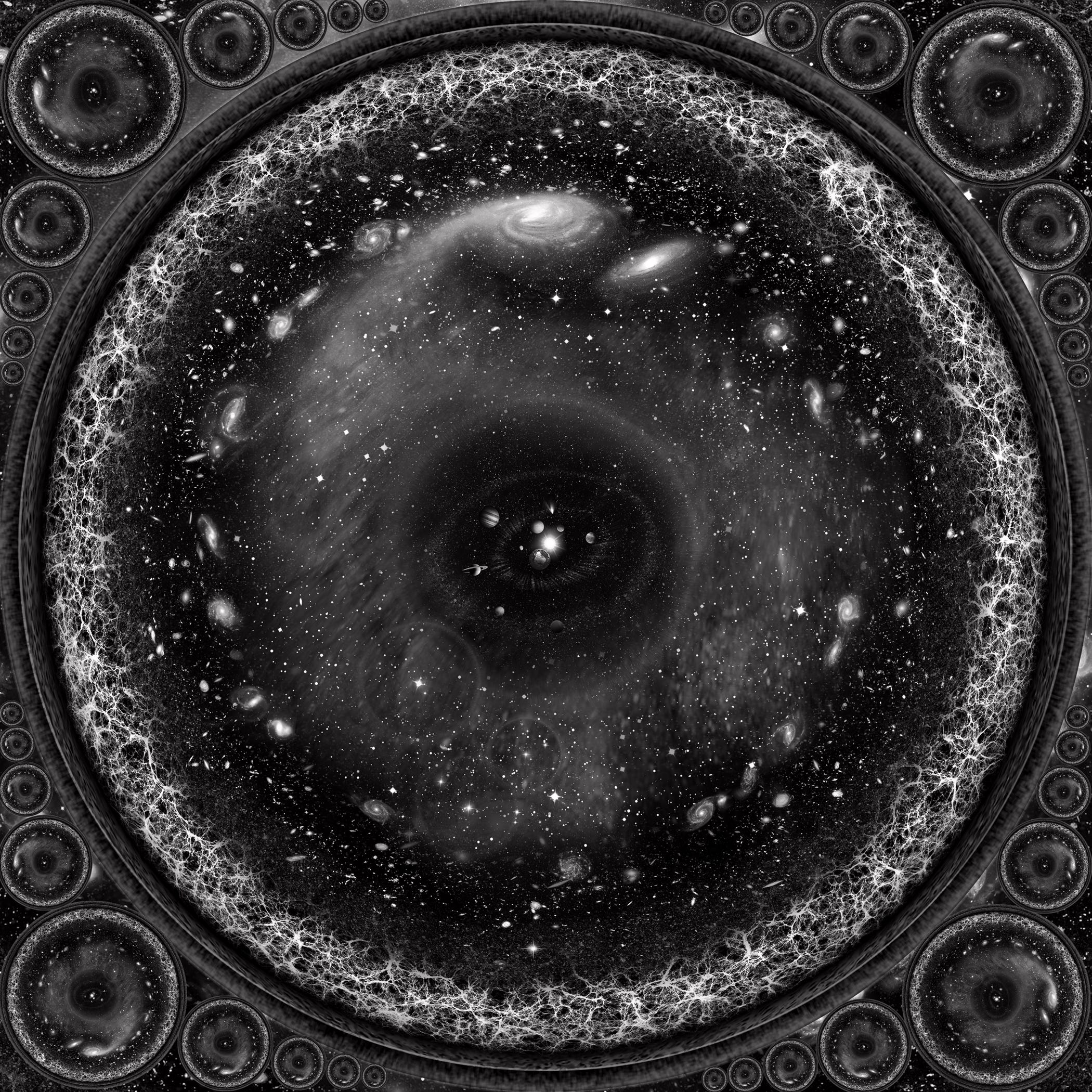
1. Cosmology imposes causal isolation
The observable universe is the region from which light, and causal influence, has had time to reach us since the recombination epoch of the early universe. The standard cosmological model suggests that beyond its horizons lies vastly more spacetime, almost certainly orders of magnitude larger, and possibly infinite, that is permanently causally disconnected from us. Regions sufficiently distant from each other recede from one another faster than light can traverse the intervening distance, making signal exchange impossible in principle. Every observer in every observable universe is similarly cut off from vast regions beyond their causal horizon.
2. Minds require causal integration
I make a minimal philosophical claim. Any mind capable of unified awareness, deliberation, and intentional action must instantiate some structure that allows informational states to be accessed, integrated, and updated. Information relevant to awareness or action must therefore be causally accessible, integrable, and updateable. Without such relations, “awareness”, “intention”, and “agency” cease to explain anything.
Causally structured states capable of access, integration, and update cannot be exchanged across causally disconnected regions. Information integration is limited to shared causal domains; there is no global domain across which information, influence, or awareness can be integrated.
3. Omnipresence rules out unified omniscience
God-concepts like those in standard Abrahamic theology assert omnipresence in a strong sense. They stipulate unified awareness, intentional action, and responsiveness in ways that bear on human action and experience. But awareness and agency invoked in this way are not basic properties. They depend on conditions sufficient for knowledge, deliberation, and intentional action. For a mind to be unified in this sense, information available in one part must be accessible to the rest. If it is not, then disconnected parts are independently aware, and there is no single subject.
In a relativistic universe, regions of spacetime can be so widely separated that no signal, information, or awareness can pass between them even in principle. If parts of a god’s presence are located in such causally disconnected regions, then under these constraints there is no basis for treating the resulting awareness as belonging to a single unified subject. Omnipresence, in this case, does not describe an extraordinary mind; it fails to specify what would count as a mind at all in the relevant sense.
4. No repair is available
Several responses suggest themselves, but none resolves the difficulty.
One might claim that information in the mind of god propagates faster than light. This directly violates relativity, one of the deepest and best-confirmed structural features of the universe, the framework that explains the cosmic microwave background, the size and shape of the observable universe, how stars burn, how gravity bends light, and why satellite navigation works. There is no way to accommodate such an exception without removing the basis on which much of modern physics and technology depends.
Alternatively, one might deny propagation altogether and claim that to god all information is immediately available everywhere. This is not a neutral metaphysical option but a stipulation that abandons causal structure. Physics shows that information arrives at different places at different times, and once that structure is discarded, the temporal and causal relations required for decision, intention, and response disappear with it.
One might deny that the god’s mind is unified in the relevant sense. The result is not a single conscious agent but a distributed field of locally aware fragments with no global integration. Since there is no unified knower, omniscience is not the property of a single subject that knows everything, but merely a claim that every fact is known somewhere. Without a unified knower, prayer, intention, and providence, which all presuppose a single subject that integrates information and acts on it, are unintelligible.
Or one might say that god exists “outside spacetime” and therefore requires no propagation of information. Being outside spacetime, it bears no relation to the expansion of the universe. To it, every instant and every place is equally accessible, since neither time nor space has any meaning. Under these conditions, the problem is not that an integrated mind is impossible, but that nothing can occur within such a mind. Without time, or causal order more generally, a mind cannot deliberate, respond, or act; it can only stand in a timeless relation to a fixed description of the universe’s entire history. Whatever its metaphysical merits, such a conception cannot explain responsiveness, intervention, or action within history, because it introduces no explanatory dependence on what happens in history at all.
Claiming that god exists in its own spacetime doesn’t solve the problem. If god explains why our spacetime exists, then a divine spacetime needs its own explanation. Moreover, the problems of information flow, temporal ordering, and causal structure remain intact if god, in its own spacetime, is to be the cause of, aware of, or responsive to events in ours.
The claim that divine cognition is “not like ours” does not help. If cognition is stripped of information flow, integration, and causal structure, what remains is not an intelligible notion of cognition but an appeal to mystery that abandons explanation.
Either an omnipresent god respects relativistic causality and cannot have unified awareness of the relevant kind, or it violates that causality and adopts an immense explanatory burden.
5. There is no cosmic “now”
There is a further and independent problem: there is no cosmological now.
In relativistic spacetime, there is no observer-independent present moment. What counts as “now” depends on the frame of reference. Events that are simultaneous for one observer are not simultaneous for another in relative motion. This is a structural feature of relativistic spacetime. Cosmology sometimes uses a convenient time coordinate, such as cosmic time in FLRW1 models, but this is a modelling choice, not a metaphysically privileged present. The universe does not consist of a stack of global instants. It consists of a four-dimensional spacetime with local time orderings and light cones.
God-concepts that ascribe awareness, responsiveness, and action within history rely on a cosmic present. God is said to know what is happening everywhere, to respond to prayers as they occur, and to act at moments. But if there is no global now, then there is no single set of events that are “currently occurring” across the universe, no privileged temporal slice on which divine awareness could be synchronised, and no coherent sense in which a god could know what is happening everywhere at the same time. Even if information could propagate instantly, there would still be no unique temporal ordering relative to which “instantaneous knowledge” could be defined.
6. No temporal repair is available
If god is said to possess a privileged global now, then relativity is fundamentally false and the universe contains a preferred frame. This is an enormous theoretical cost, adopted solely to rescue a god.
If god exists outside time altogether, then temporal predicates such as “before”, “after”, “simultaneous”, and “now” do not apply to it, but as we have seen, this implies that god is mindless.
If god’s knowledge is indexed to local frames, then divine awareness is fragmented across incompatible “nows” and lacks any single unified consciousness.
The absence of a global now is not a physical limitation that can be waved away by saying that god is unconstrained by physics. It is a constraint on what temporal notions are defined. The concept of knowing what is happening now everywhere simply does not correspond to anything real in our kind of universe.
7. Exemption withdraws explanation
The theistic response might be to exempt the god-concept from cosmology altogether and to claim that god is non-spatial, non-temporal, not informational or causally active in any sense continuous with physical processes. This shifts the concept’s role from explaining events within the world to standing apart from them. Omnipresence is reinterpreted as ontological dependence; omniscience as tenseless knowledge of the spacetime block; omnipotence as a timeless willing of the universe’s entire history.
These moves do not answer the objection; they concede it. None of them is supported by independent constraints arising from cosmology, physics, or causal explanation. None has an analogue among entities invoked elsewhere to explain action or events. They are not discoveries forced by cosmology but stipulations introduced to preserve the god-concept. Even granted for the sake of argument, they do not restore a cosmic now or a unified perspective capable of supporting awareness, responsiveness, or action within history.
Predicates such as “knowing”, “acting”, and “being present” might be claimed to apply by analogy rather than univocally. But if “knowing” and “acting” no longer involve anything like finding out or doing something and we drop information flow, temporal order, and causal connection altogether, then these predicates stop explaining anything and function only as labels.
8. The explanatory fault line
Once god-concepts are made explicit enough, they fracture along a fault line that appears wherever a concept is asked both to explain events and to stand outside the conditions that make explanation possible. Either god is described in terms rich enough to support awareness, responsiveness, and action within history, in which case those descriptions collide with the causal and temporal structure of the world; or god is exempted from that structure, and no longer explains anything.
Elsewhere, exemption from constraint counts as explanatory failure; exempting god is somehow viewed as insight into its mysterious ways.
9. The coral god
In a universe governed by relativistic causal structure, no single locus can integrate information across all of spacetime. Horizons limit access; simultaneity is frame-dependent; causal influence propagates locally. The preceding sections argue that standard god-concepts collide with these facts in ways that admit no repair. What, if anything, would a god-concept compatible with these constraints look like?
A coral colony is a physically continuous structure generated by local processes, without any central organiser or internal point of view. Growth occurs incrementally at many sites at once, with each region responding primarily to conditions in its immediate vicinity. Neighbouring regions influence one another through direct contact, while interactions weaken with distance and do not amount to any colony-wide integration. The colony persists and changes over time, yet no part of it can apprehend, represent, or govern the form of the whole. As a metaphor, a coral colony captures some aspects of a god that is continuous in presence but fragmented in cognition.
9.1 Localised awareness without global selfhood
A cosmological god is not a unified subject with a single perspective on “everything that is happening now.” Divine awareness and agency are instead indexed to causal standpoints. For any given observer, the god they can address, relate to, or be acted upon by is determined entirely by that observer’s observable universe, the totality of events from which information could in principle have reached them. What counts as “the divine mind” for a believer on Earth is therefore not identical to what counts as the divine mind for a believer in Andromeda, because their observable universes differ, however slightly. This divergence is continuous rather than discrete and admits no sharp boundaries beyond those imposed by causal horizons themselves.
Nothing in this account presupposes a determinate number of divine subjects, or even that “subjecthood” is a well-defined property at the scale of spacetime. The description is framed entirely in terms of local realisations of awareness and agency relative to causal standpoints.
9.2 Omniscience without integration: causal horizons
Informational isolation beyond causal horizons is a structural feature of a relativistic universe. Where no causal relations exist, no integrative facts exist either. Under these conditions, there is no fact of the matter accessible to any subject, divine or otherwise, about the true global structure of this distributed divinity. Divine ignorance, in this sense, is unavoidable.
9.3 Omniscience without access: finite cosmic time
It might be objected that even if distant regions of spacetime are causally disconnected, information about them could still propagate indirectly. Consider three spacetime points, A, B, and C. Suppose B lies within the observable universes of both A and C, while A and C lie outside one another’s observable universes. B can receive information from C and later transmit information to A. In this way, A can learn facts about events that occurred at C.
No. It definitely can’t.
The boundary of any observable universe is both spatial and temporal. The furthest distance we can see in any direction is defined by the surface of last scattering, which marks the earliest epoch from which electromagnetic information can propagate freely. Other carriers, such as neutrinos or gravitational waves, may in principle provide access to slightly earlier epochs, but none permit arbitrarily extended chains of observation or testimony. There is no standpoint prior to these early boundaries from which records, memories, or knowledge-bearing processes could originate.
Consider a spacetime point A and a point B lying well within A’s observable universe. Because B lies in A’s past, B’s own observable universe is necessarily smaller than A’s and bounded by a surface of last scattering that occurs earlier in A’s causal past. Any region C lying beyond that boundary is not merely unobserved by B, but epistemically inaccessible to it in principle. The question is therefore not where C is, but when it was. From A’s standpoint, no information about such a region could be transmitted via B, because B itself has no causal or epistemic access to it. If B lies arbitrarily close to the edge of A’s observable universe, and hence arbitrarily early in A’s past light cone, no regions earlier than B are accessible to B, because they lie prior to the earliest epoch at which information-bearing processes operated. As one approaches the Planck epoch, even this minimal notion of information breaks down.
The Planck epoch marks a limit not just on human knowledge but on knowledge tout court, since beyond it no coherent notion of information, causation, or observation applies. Any god said to know this universe is subject to that limit. Exempting god from this constraint does not rescue omniscience; for reasons already established, it obliterates its cosmological relevance.
For the purposes of knowledge, the answer is no; A cannot find out anything about C from B.
This places an absolute limit on mediated knowledge within the coral god. Chains of testimony run out of time. No sequence of overlapping causal domains can recover information about events prior to the earliest epoch at which information-bearing processes can exist. The coral god cannot accumulate knowledge of its own origin, not because such knowledge is dispersed, but because there is no possible causal route by which it could be acquired.
9.4 Omniscience distributed and fragmentary
Even locally realised divine awareness cannot know whether it existed earlier, whether creation occurred elsewhere, or whether the early universe shared the same properties across different causal domains. There is no standpoint from which such facts could be known.
Knowledge within the coral god is therefore bounded not only by spatial horizons but by the finite depth of cosmic time. Testimony can connect overlapping regions at later epochs, but it must always terminate at an early boundary beyond which no information-bearing processes, records, or transmissible awareness could exist. There is, in principle, no standpoint from which the coral god could integrate knowledge of either its full spatial extent or its temporal origin.
Divine omniscience, under these conditions, is collective rather than centralised. Every fact may be known somewhere within the divine system, but there is no single knower who knows all facts together. Likewise, omnipresence is not the presence everywhere of one mind, but the presence everywhere of locally realised centres of awareness and agency.
9.5 Prayer and providence without a unified subject
Prayer is addressed not to a globally omniscient subject but to the locally relevant region of divine awareness, the part of god that stands in causal relation to the praying person and their circumstances. Responses to prayer are therefore local and contextual, shaped by what that region can know and do. Incompatible divine responses to similar prayers are an inevitable consequence of causal isolation.
Providence, too, is necessarily piecemeal rather than total. The divine system cannot govern the universe according to a single, all-encompassing plan. Instead, it sustains and guides events locally, adapting to circumstances as they unfold within each causal domain. There can be no overarching order imposed from a single, unified perspective.
A single universe is a single spacetime, and a single spacetime is defined by a single causal geometry. Regions may be causally disconnected, but they are disconnected by the same light-cone structure everywhere. If causal propagation is finite anywhere, that finitude is a property of the spacetime itself and therefore applies universally.
10. Creation without global dominion
In a relativistic setting there is no global standpoint from which the universe exists “all at once,” no observer-independent temporal origin from which a creative act could be undertaken, and no unified perspective capable of underwriting a single creative decision. A god compatible with such a universe therefore cannot be the creator of the universe as a totality. Any divine agency is indexed to a particular causal standpoint and determines creation only within its region of spacetime. There is no global act of creation that fixes the structure of the universe everywhere.
Inflationary dynamics or the values of physical constants that characterise the early universe in any one causal domain need not do so in causally disconnected regions. Creation is therefore a pattern of local bringings-about distributed across spacetime. Different regions cannot share a single creation history, and it is in principle impossible for these histories to belong to one creative process, since no causal chain could ever connect or unify them. A distributed god cannot be a unified creator or exercise universal dominion over creation, because there is no integrated subject from whose perspective such dominion could be recognised or maintained. In an infinite relativistic universe, the absence of any global mechanism capable of enforcing uniform creative conditions makes variation unavoidable, including regions that unfold without any creator at all.
The stories that finite creatures, embedded in a single causal domain, tell about creation may be indistinguishable from those told about an Abrahamic god. But such stories, even if true locally, have no purchase beyond the causal domain in which they arise. In a relativistic universe, there is no sense in which a creation narrative formulated within one domain could apply to the universe as a whole.
11. Why the god-concept fails to apply
The universe we inhabit is unforgiving of concepts that claim to explain everything while answering to nothing. When a god is placed within the world it is meant to illuminate, the traditional attributes of unity, omniscience, omnipresence, and global providential control cannot be retained without abandoning the causal and temporal structure revealed by cosmology. What remains is a fragmented, locally realised, and globally opaque system of divine awareness and agency.
From the standpoint of any finite creature, a local manifestation of such a system could be indistinguishable from the god of Abrahamic theism. A being that answers prayer, intervenes in history, issues commands, or presents itself under particular cultural forms would, within a single causal domain, satisfy all the practical and experiential roles assigned to this kind of god. The coral god therefore does not fail by being explanatorily inert; it fails by being explanatorily underdetermined. The same local phenomena are equally compatible with a distributed divine process, with many independent god-like agencies, or, necessarily, with no god at all.
In the absence of any independent evidence for a unified divine system extending beyond particular causal domains, there is no rational pressure to interpret local phenomena as manifestations of a god at all, rather than as events exhaustively explained by the causal structure in which they occur. Cosmology does not leave room for a distributed deity awaiting unification; it removes the conditions under which the concept of god could meaningfully apply. Once global selfhood, universal dominion, and unified creation are ruled out in principle, the god-concept ceases to refer. Abandoning it is not a matter of economy or restraint, but of recognising that nothing remains for it to denote.
Friedmann, Lemaître, Robertson, and Walker models models assume that at cosmic scales the universe has the same average properties everywhere and looks the same in every direction. They specify a spacetime geometry consistent with general relativity, a scale factor that describes how distances between points change over time, and the global expansion (or contraction) history of the universe.
Struth. You’ve made me remember why I gave up going to Philosophy lectures at Cambridge. Way over the top of my pudding-stuffed atheist head, I’m afraid.
Fascinating dismantling of omnipresent deity concepts under relativistic constraints. The casual horizon argument is especially sharp beacuse it doesn't just limit divine knowledge, it undermines the coherence of unified subjecthood itself. I hadn't considered how the absence of a cosmic now fragments prayer and providence into locally-indexed interactions. The 'coral god' framework is an honest reckoning with what survives when theology meets cosmology, though it essentially concdes that what remains isn't the classical god at all.